Open cooling basins are among the biggest water consumers in industrial cooling technology. Thousands of liters of cooling water are lost daily through evaporation, spray, and wind erosion – a cost factor that can be drastically reduced with the right cover solution. For those looking to cover their cooling basins, floating technical cover spheres offer an economical and low-maintenance alternative to rigid covers.
Why open cooling basins are a problem
Cooling basins and cooling water basins are an integral part of many industrial processes – from plastics processing and metal finishing to energy generation. They operate on the principle of evaporative cooling: heat is released into the surrounding air via the water surface.
However, this very mechanism leads to significant operating costs:
- Water loss through evaporation: Depending on the pool temperature and weather conditions, several liters of water evaporate daily per square meter of open water surface. For industrial pools ranging from 50 to 500 m², this adds up to thousands of cubic meters per year.
- Dessert costs: Lost water must be continuously treated and replenished – including chemicals for water treatment.
- Energy loss: Evaporation extracts thermal energy from the cooling water. In systems with defined supply/return temperatures, this increases the energy consumption of the refrigeration system.
- Pollution and algae growth: Open pools are exposed to dust, leaves, insects, and UV radiation. This promotes biofilm formation and increases maintenance requirements.
The article "Reducing temperature peaks and lowering energy costs" shows how much a cover affects temperature control.
Legionella risk: An often underestimated factor
A particularly critical issue with open cooling water systems is the risk of Legionella. Cooling basins, with water temperatures between 25 and 45 °C, offer ideal conditions for the growth of Legionella pneumophila . The 42nd Federal Immission Control Ordinance (42nd BImSchV) obliges operators of evaporative cooling systems to conduct regular inspections and implement measures to minimize the risk.
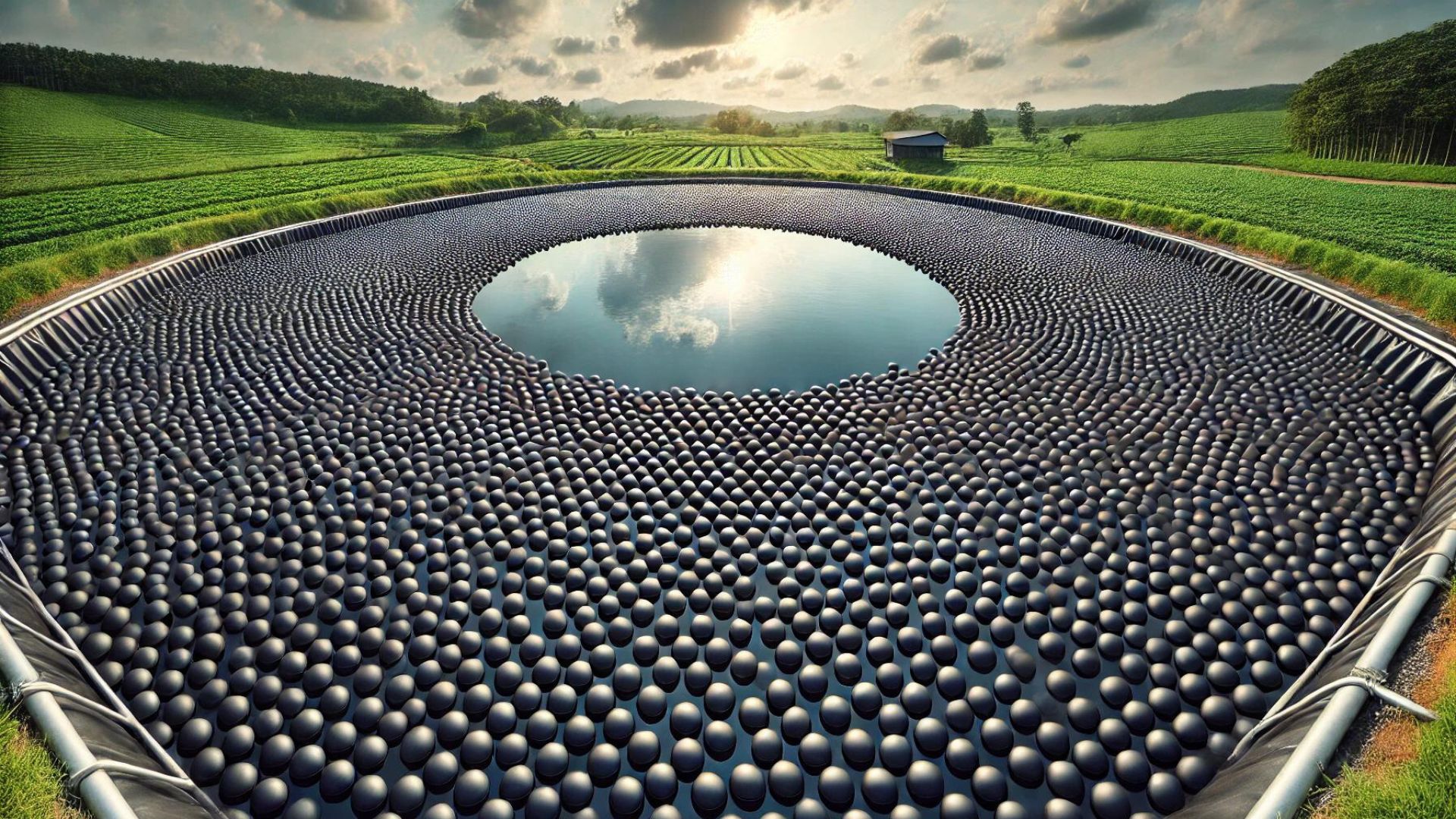
Covering a cooling basin reduces the free water surface area by up to 91%, thereby also reducing aerosol formation – a key transmission route for Legionella bacteria. While cover spheres do not replace water treatment, they significantly support the overall strategy for germ reduction.
Floating cover balls: Functional principle and advantages
EURO-MATIC technical cover spheres are hollow plastic spheres made of HDPE or PP, which are applied as loose fill to the water surface. Due to their spherical shape, they automatically arrange themselves in a hexagonally dense structure, thus covering approximately 91% of the surface.
Advantages over rigid covers
| Criterion | cover balls | Rigid cover |
|---|---|---|
| Adaptation to fluctuations in fill level | Automatic | Complex construction required |
| Installation | Simple dumping, no crane required | Installation with substructure |
| Maintenance access | push the balls aside | Remove completely |
| wind stability | Self-stabilizing | Fastening required |
| Lifespan | > 15 years (UV-stabilized) | Material dependent |
| Retrofitting existing pools | Sofort möglich | Structural modifications are often necessary. |
Measurable savings
The effectiveness of floating cover spheres on cooling basins has been demonstrated by numerous practical projects:
- evaporation reduction: up to 90% less water loss
- Energy saving: 50–75% less heat loss through the surface
- Chemical consumption: Significantly lower demand for biocides and corrosion inhibitors
- Depreciation: Usually within 6 to 18 months
This is how retrofitting works in practice
Covering the cooling basin with cover spheres requires no structural modifications. The process is extremely simple:
- Inventory: The basin geometry, water temperature, medium and existing fixtures (nozzles, overflow channels, sensors) are recorded.
- Material selection: Depending on the temperature and water chemistry, HDPE spheres (up to approx. 80 °C, very good UV stability) or PP spheres (up to approx. 100 °C, broad chemical resistance) are used.
- Dimensioning: The required number of balls is determined by the basin's surface area and the ball diameter. (About the) Configurator for technical cover spheres Material, quantity and packaging can be determined in just a few steps.
- Application: The spheres are simply poured onto the water's surface. They spread out on their own and immediately form a continuous covering layer.
- Business: No maintenance required. If necessary, individual spheres can be easily moved aside for inspection or cleaning.
Typical areas of application
Floating cover spheres for covering cooling basins are used in numerous industries:
- Plastic processing: Injection molding and extrusion systems with central cooling water supply
- Metal processing: Cooling of rolling mills, presses and hardening tanks
- Energy industry: Cooling in power plants and combined heat and power plants
- Chemistry and pharmaceuticals: Process water cooling with increased water quality requirements
- Data Centers: Free cooling systems with open cooling basins
An overview of other industrial applications is given in the article Effective evaporation protection in industry.
Economic efficiency calculation: A practical example
Initial situation: Cooling basin of a medium-sized plastics processor, 80 m² surface area, water temperature 35 °C, operating time 6.000 h/year.
| Position | Ohne Abdeckung | With cover balls |
|---|---|---|
| Water loss through evaporation | approx. 2.400 m³/year | approx. 240 m³/year |
| Water costs (including treatment) | approx. €12.000/year | approx. €1.200/year |
| Energy loss (reheating) | approx. €8.500/year | approx. €2.500/year |
| Chemicals Water treatment | approx. €3.000/year | approx. €1.000/year |
| Annual savings | about 18.800 € | |
| Investment costs (one-time) | approx. 6.000–9.000 € | |
| Amortization | 4-6 months |
Values are exemplary and vary depending on location, weather and operating conditions.
Conclusion: Covering cooling basins is worthwhile.
For those wishing to cover their cooling basins, floating cover spheres offer an immediately effective, maintenance-free, and retrofittable solution. The combination of evaporation protection, energy savings, and reduced risk of Legionella makes cover spheres the most economical option for open cooling water basins in industrial settings.
EURO-MATIC offers personalized advice on the optimal dimensions and material selection for your cooling tank. Determine the material and quantity directly in the configurator or request a free initial consultation.