Rainwater retention basins are inconspicuous structures – until they attract attention. Then a layer of algae forms on the water, an odor emanates from the direction of the basin, or residents complain about mosquitoes.
The fundamental problem is inherent in the design: an open pool with stagnant, nutrient-rich water that lies in the sun for weeks is an ideal habitat. A cover addresses precisely this issue.
Why open retention basins cause problems
Four effects regularly occur together:
Algae. Rainwater from streets and roofs carries nutrients. Combined with sunlight and stagnant water, this leads to an algal bloom in the summer months – unsightly and oxygen-consuming as it decomposes.
Odor. When oxygen in the water becomes scarce, decomposition processes continue without it. The result is an odor, which can reach even the surrounding buildings.
Mosquitoes. Stagnant water without current is a breeding ground. In ponds near settlements, this is the point at which a technical structure becomes a source of complaints.
Birds. Open water surfaces attract waterfowl. Their droppings introduce additional nutrients, thus reinforcing the cycle that promotes algae growth – in ponds near airports, the problem of bird strikes is an additional factor.
The processes reinforce each other: More nutrients mean more algae, more algae decomposition means less oxygen, less oxygen means odor.
What makes covering retention basins difficult
The obvious solution is a fixed cover. However, this often fails in the case of rainwater retention basins due to a characteristic that defines the structure itself: the water level fluctuates considerably.
That's precisely what the basin is designed for. After heavy rain, it fills up within hours, then drains again at a controlled rate. There's often a difference of several meters between dry weather and when the reservoir is full.
A rigid cover would have to accommodate this range. Either it rests on the bottom of the pool when the water level is low, or it is lifted when the pool is full, putting stress on its mounting. In addition, the inlet, throttling device, and emergency overflow must remain unobstructed.
Floating cover balls: why they fit here
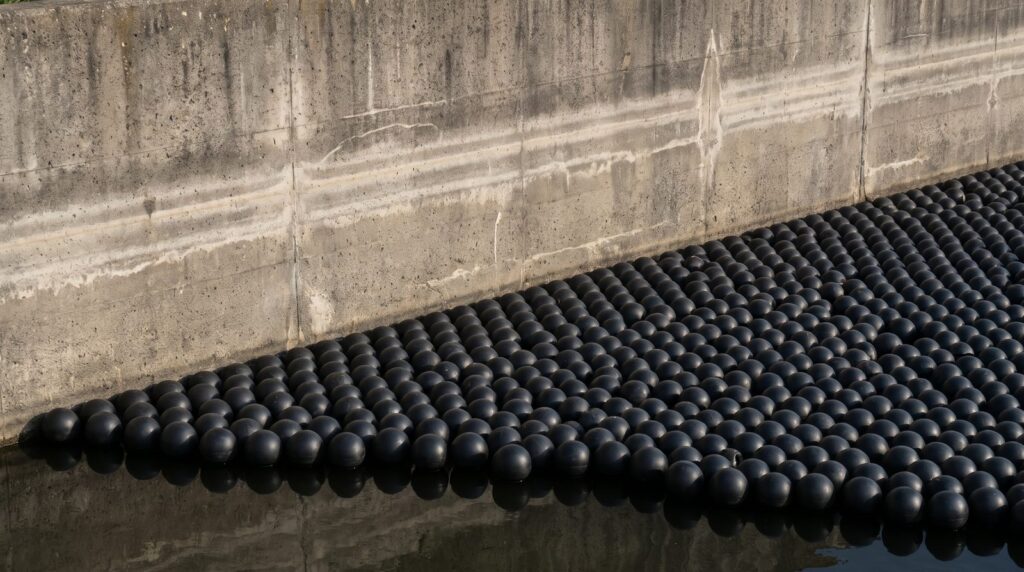
Cover spheres are hollow plastic spheres that are loosely poured onto the water's surface. They self-align to form a dense layer, covering approximately 91 percent of the area – geometrically, this is the maximum possible coverage between round objects.
For retention basins, the crucial property is different from density: the layer follows the water level. It rises with the water level as it fills and falls again as it drains, without any mechanical components or fixings. What is the main problem with a rigid cover is completely eliminated here.
The following effects result from this:
- Light deprivation: Without sunlight, algae growth lacks the necessary conditions. The reasons for this are explained in the article on... Algae prevention with hollow spheres.
- Odor reduction: The closed layer limits the exchange between the water surface and the air.
- Mosquito protection: The covered surface is no longer available as a breeding ground.
- Bird deterrent: The area becomes unattractive to waterfowl as a landing place. For ponds near airfields, this is the primary reason – hence the... Bird Balls.
- Evaporation protection: In pools where the water is reused, reduced evaporation also comes into play. The magnitude of this is shown by the evaporation calculator.
What needs to be clarified during the planning phase
Inlet and outlet. The balls would otherwise accumulate where water flows in or out. A rim or a float ring around the throttling device keeps the area clear. This point should be at the beginning of the planning process, not at the end.
Emergency overflow. The balls float to the surface. In case of overflow, the design must ensure that they are not carried away – a baffle or a grate in front of the overflow solves this.
Slope gradient. In gently sloping earth basins, the water surface area changes more with the water level than in steep concrete basins. The amount depends on the area at the normal operating water level, not on the maximum impoundment area.
Accessibility for entertainment purposes. The panel can be slid aside and then closes automatically. This poses no obstacle for patrols and evacuation, but should be coordinated with the operating personnel.
Differentiation from other pelvic types
The solution is not limited to stormwater retention basins, but the boundary conditions differ. For wastewater treatment basins, the contribution for clarifier covers applies ; for process and industrial basins with chemical exposure, the material selection is crucial – you can find this information under the technical cover spheres.
Advice for your pelvis
The appropriate sphere size, material, and quantity for your pool depend on its surface area, water level range, and usage. Torben Steinfeld-Schinkel will discuss the design with municipalities and operators – free of charge and without obligation.
You can reach us at info@euro-matic.de or +49 5542 93290.