Ball pit on the aeration tank
The Langenreichenbach wastewater treatment plant, operated by the Heidelbach Wastewater Association, treats the wastewater from the municipalities of Mockrehna, Thallwitz, Belgern-Schildau, and part of the town of Torgau in the district of Nordsachsen, Saxony, and has a treatment capacity equivalent to 16.000 population equivalents (PE). The last expansion, to a two-lane activated sludge plant with simultaneous aerobic sludge stabilization, was completed in 2002. The plant is currently operating at approximately 83 percent of its potential capacity. We have stricter requirements regarding nitrogen discharge into receiving waters. The NH₄ - N concentration must remain below 3 mg/l, and the total nitrogen concentration below 10 mg/l. We reliably maintain these limits, but close monitoring and control of the biological treatment processes are essential.
For several years now, we've seen an enormous growth of duckweed on our aeration and secondary clarifiers. The duckweed develops so magnificently that it forms a thick carpet on the water surface. This wouldn't be a problem at first, but our measuring probes, the automatic sampler, and the sludge lines are sticking together and becoming clogged. To ensure the equipment always functions properly, we have had to spend a disproportionate amount of time cleaning it.

Fig. 1: Duckweed carpet must be laboriously removed with a vacuum truck
Since we had no way to prevent the duckweed from growing, our only option was regular removal. We used a homemade floating beam and a few lines to pull the duckweed from one side of the tank to the other, then vacuumed it from the surface with a vacuum truck. To get the "duckweed" to the suction hose, we also had to shovel it all up. The work took at least a day for each of the two denitrification and anaerobic tanks. A total of four people and a vacuum truck were involved each time, and in some years, this happened up to three times.
A television report on Galileo gave me a completely different idea for our problem. The report featured a drinking water reservoir that had been covered with floating balls. The goal there, however, was to reduce the high rate of water evaporation. But why shouldn't the floating balls also help with our duckweed problem? It was worth a try. After a short internet search, we found a supplier for the floating balls: Uwe Steinfeld GmbH EURO – MATIC. The floating balls, called BirdBalls ™ , are made of UV-stabilized HDPE and have a diameter of 100 mm. They are typically used to protect bodies of water from birds, algae growth, and water loss through evaporation.
To test the success of the idea , we initially equipped only one of the four affected pools with the floating balls. Completely covering the surface of the anaerobic pool required approximately 18.000 balls, which were delivered in 11 big bags. We simply placed the floating balls on the pool surface at an accessible point. The floating balls then distributed themselves evenly across the entire surface.
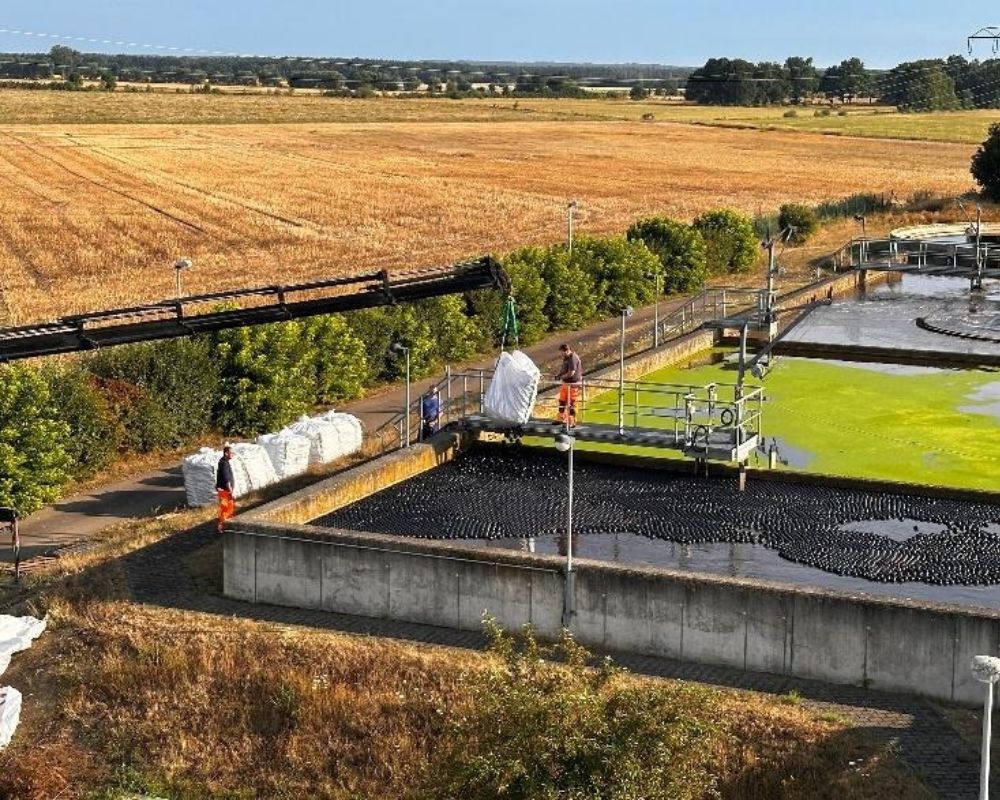
Fig. 2: Inserting the swimming balls
We gave ourselves a year to assess the effectiveness of the floating balls. Ultimately, we were able to determine that, over the entire period, the duckweed problem was indeed contained and the floating balls never interfered with the regular operation of the pool.
Therefore, we decided to fill the other three pools completely as well. This required the delivery of an additional 57 big bags and a total of 88.350 swimming balls. However, we saved ourselves the trouble of recounting the balls for accurate billing.
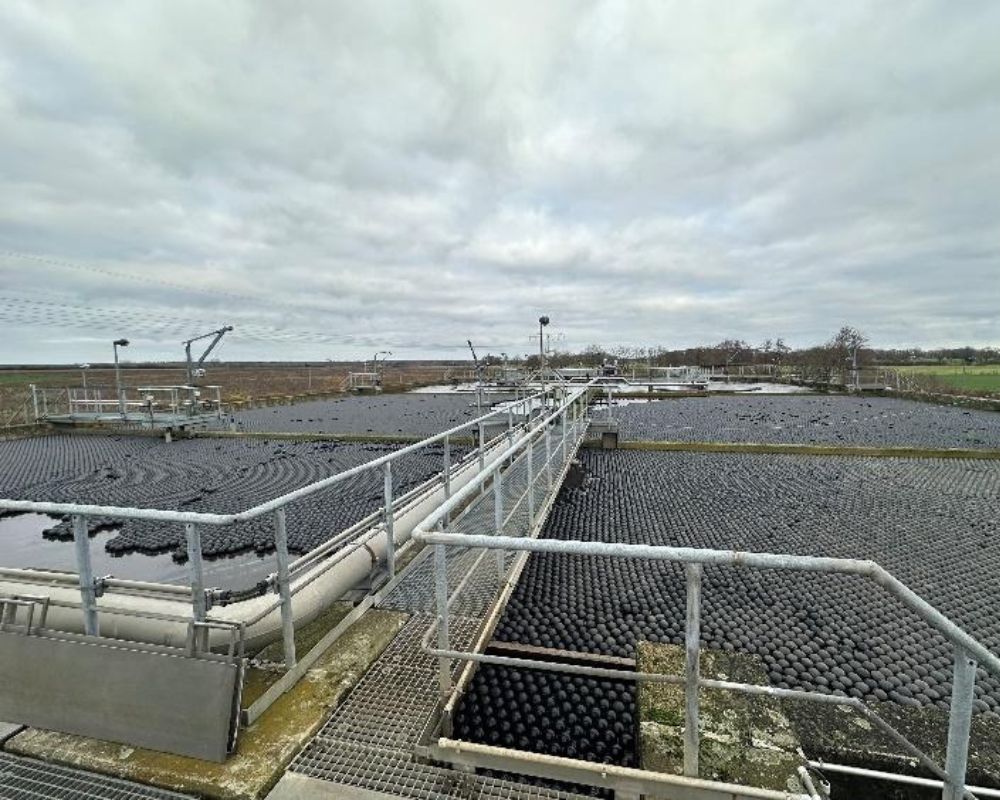
From 3: all affected pools are occupied with swimming balls
A nice side effect we're hoping for would be heat storage in the covered pool, keeping the water temperature above 11°C for as long as possible, even during the colder seasons. This would ensure nitrogen degradation over a longer period and would provide even better protection for the downstream water body. However, we don't yet have any measurable results for this.
Author
Ted Linke
Head of sewage treatment plant/sewer network
Heidelbach Wastewater Association