1) Define goals – what are you setting out to achieve? Bird Balls™ on?
Before you calculate, clarify the intended use. Is it primarily about...?
- Reduce evaporation (e.g., storage/rainwater basins),
- Reduce light exposure (e.g. to prevent algae growth in outdoor pools),
- Reduce pollution/entries from above,
- Keep wild birds away (visual barrier/covering large bodies of water),
- Stabilize the temperature (less heating at the surface)?
Your goal influences the ball size, the choice of color/material, and the quantity.
2) Determine the area accurately
The basis of your planning is the free water surface area in m².
- Rectangle/square: Length × Width.
- Circle: π × (radius)².
- Irregular shapes: divide into sections or determine using GIS/plan dimensions.
Additionally, note down edge areas, inlets/outlets and sloping embankments (retaining strips may be useful there).

3) Choosing the diameter – balancing appearance, function & wind load
Typical sizes range from approximately 50-100 mm, depending on the application. Orientation :
- 50-75 mm: finer "coverage pattern", high coverage; good for smaller pools when appearance/uniform coverage is important.
- 75-100 mm: robust in wind/wave conditions, proven on larger, exposed areas; lower quantity required per m².
For outdoor use, UV-stabilized plastics are suitable for long service life. Many users prefer a dark finish for privacy/UV blocking.
4) Calculating the quantity – the practical formula
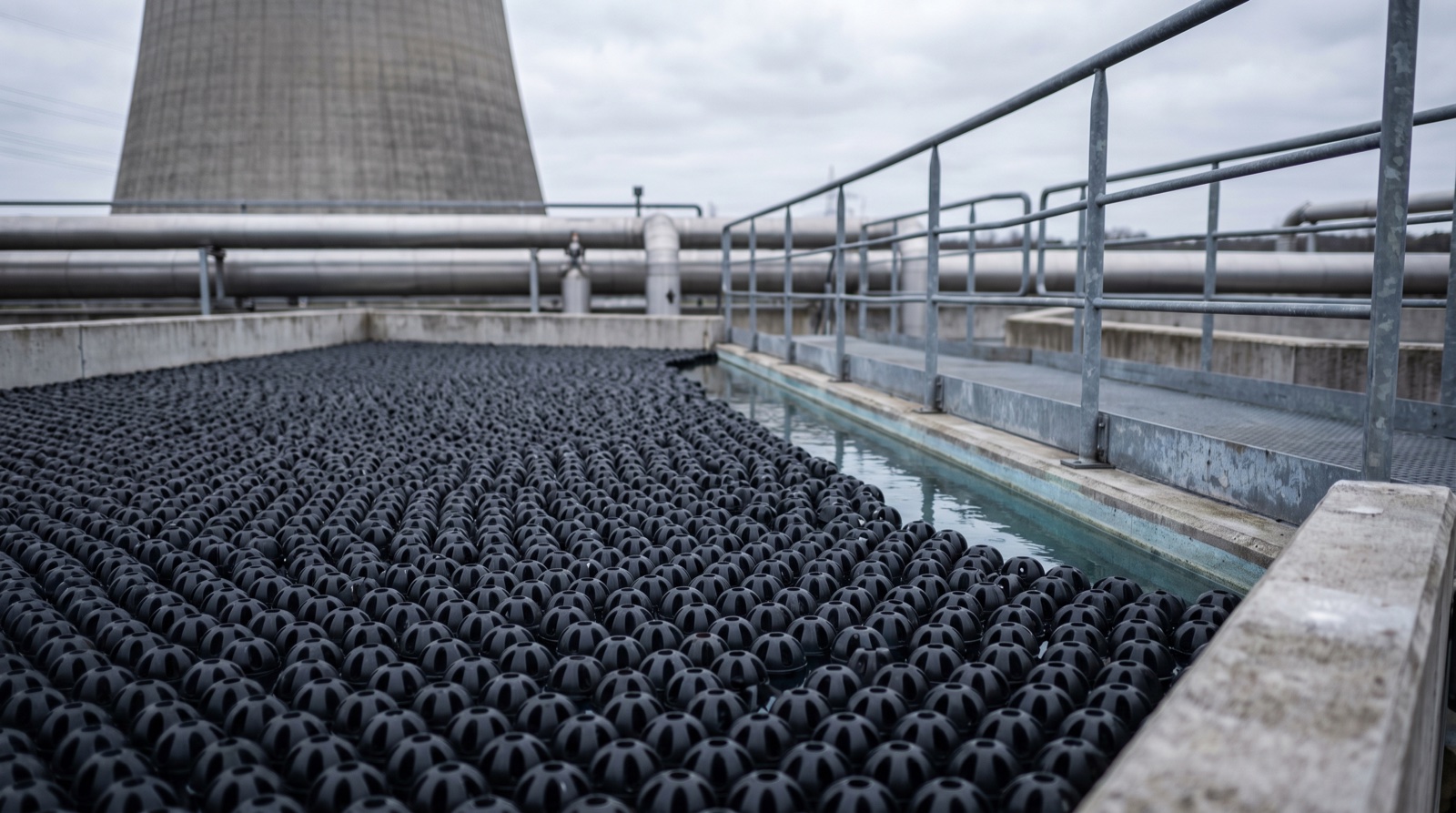
Bird Balls™ form an almost continuous layer on the surface. The following guideline has proven useful for calculating requirements:
Required quantity N ≈ A / (0,91 × π × (d/2)²)
- A = Pool area [m²]
- d = sphere diameter [m]
- 0,91 ≈ typical coverage of an inlay layer
This is how you determine the number of pieces needed for complete coverage. Examples (guide values per m²):
- d = 50 mm (0,05 m): approx. 560 spheres/m²
- d = 75 mm (0,075 m): approx. 249 spheres/m²
- d = 100 mm (0,10 m): approx. 140 spheres/m²
Tip: Include a safety margin of 5-10% – for edge zones, slopes, water level fluctuations and losses during operation/inspection.
5) Consider environmental conditions
A short practical check is worthwhile to ensure a permanently stable cover:
- Wind & Waves: Larger diameters are more wind-resistant; for highly exposed areas, consider including retaining strips or segmenting the pool surface.
- Inlets/outlets & overflows: Simple strips/nets prevent the balls from being blown off course.
- Maintenance & Access: Bird Balls™ require little maintenance and can be moved aside for inspections – plan for suitable access and safe walkways (ball layer is not walkable).
- Documentation/Labeling: Labeling at the pool edge, defining responsibilities and inspection intervals (e.g. visual inspection, rough cleaning as needed).
6) Example calculation: how to plan Bird Balls™ correctly
A rainwater storage tank with an area of A = 1.000 m² needs to be covered. The location is exposed to wind, therefore the thickness (d) is 100 mm.
- Number of pieces per m²: approx. 140
- Total requirement: 1.000 × 140 = 140.000 Bird Balls™
- Surcharge of 10% for margins & variations: +14.000
- Order quantity: ≈ 154.000 pieces
With this dimensioning you achieve a very high area coverage and thus the desired effects (light/evaporation reduction, privacy protection) – robust even in windy conditions.
7) Checklist – Dimensioning & Quantity (Compact)
- Define the objective: Evaporation? Privacy screen? UV/light reduction?
- Determine area A (m²) including edge/sloping areas.
- Choose diameter d: 50-100 mm depending on wind/area/appearance.
- Calculate the requirement: N ≈ A / (0,91 × π × (d/2)²); +5-10 % reserve.
- Secure edges/inlets & outlets, define access points.
- Plan maintenance: Visual inspection; move/clean balls to the side if necessary.
FAQ
What are Bird Balls™ suitable for and what goals can I achieve with them?
Bird Balls™ can be used in a variety of ways – for example, to reduce evaporation, to block light and prevent algae growth, as a privacy screen, to deter wild birds, or to stabilize water temperature. The specific objective influences the selection and planning (e.g., ball size, color, quantity).
How do I calculate the required number of Bird Balls™ for my aquarium?
The number of pieces depends on the water surface area in m² and the chosen sphere diameter. Using the formula...
Quantity ≈ Area / (0,91 × π × (d/2)²)
You can determine your needs. Plan an additional 5-10% reserve for edges, embankments, and water level fluctuations.
What ball size is right for my project?
For smaller pools or for visually uniform coverage, 50–75 mm Bird Balls™ are suitable. For larger or wind-exposed areas, 75–100 mm balls are better, as they are more robust against wind and waves. The choice also affects the number of balls required per square meter.