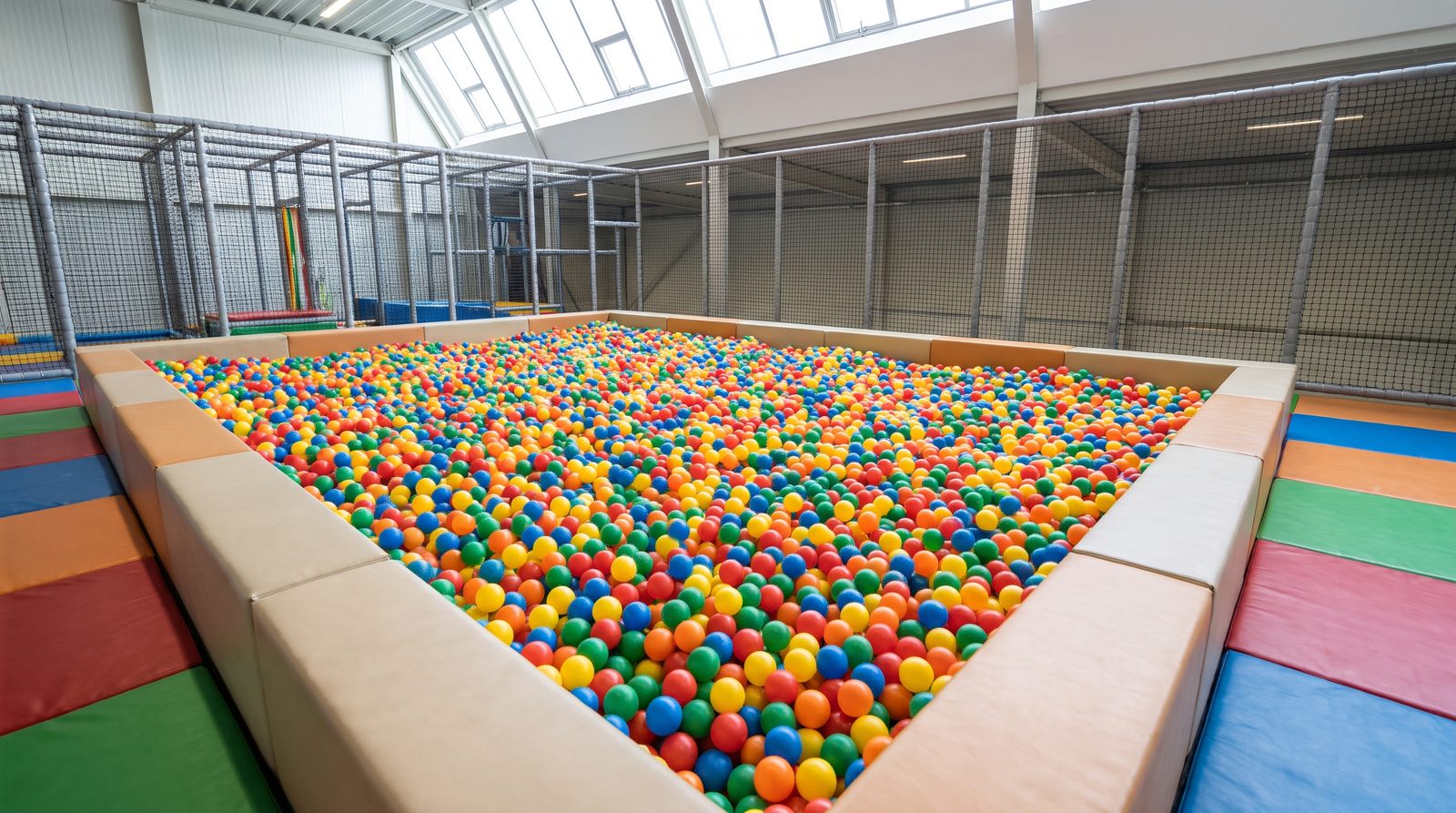
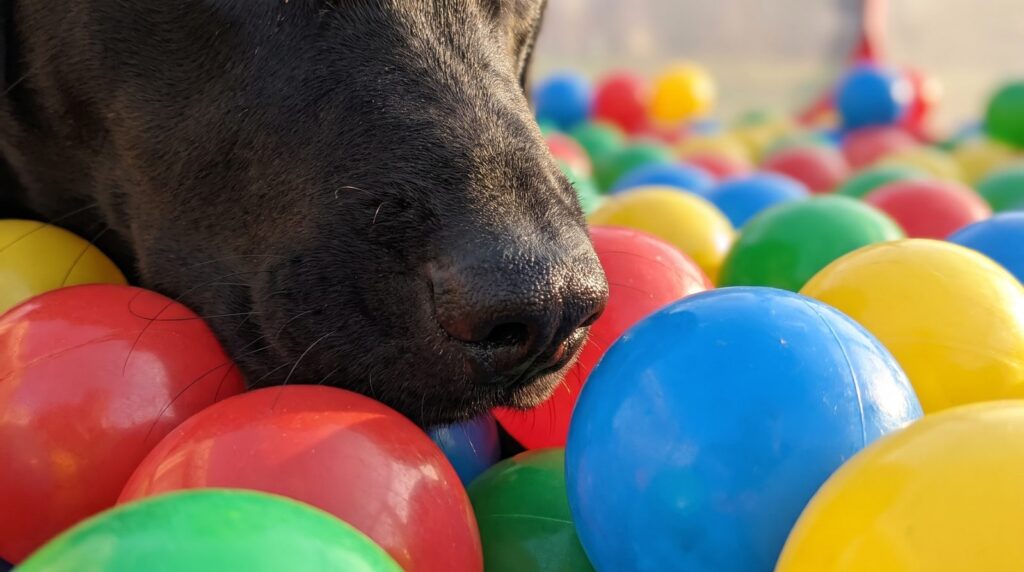
What has long been established in early childhood development is now catching on in dog training schools, animal physiotherapy, and dog daycares: a pool full of balls as a stimulating and enriching environment. For dogs, it's primarily one thing – a olfactory landscape they can explore.
However, the requirements differ significantly from those of a children's ball pit.
The most important point first: the ball size
A ball that fits in the mouth can be swallowed or block the windpipe. This isn't a theoretical risk – it's the reason why ball size is paramount when it comes to dogs.
The rule is simple: The ball must be significantly larger than what the dog could swallow. The benchmark is not the average dog, but the largest dog that uses its pelvis. A ball that is harmless for a Chihuahua can be dangerous for a Labrador.
Therefore, for mixed groups, the ball size always depends on the largest animal. Those keeping animals of different sizes either need consistently large balls or separate pools.
Two further points are related to safety:
- No damaged balls in the pool. A dented or cracked ball can have sharp edges and will splinter under further pressure. Damaged balls should be discarded immediately, not used in the next round.
- No unattended use. This also applies to dogs that have known the pool for months.
Material: What dog teeth have to withstand
Dogs treat balls differently than children. They pick them up in their mouths, carry them around, chew on them, and press into the ball with their full body weight.
This results in three requirements for the material:
Bite resistance. The ball must yield without splintering. Brittle material that breaks under tooth pressure is unacceptable – the fragments are the real problem, not the destroyed ball.
Free from harmful substances. What children put in their mouths, dogs will put in their mouths even more often, and much more intensely. The same requirements apply here as well.
Closed surface. Saliva is the main cause of soiling. Porous or roughened surfaces cannot be reliably cleaned.
Euro-Matic balls are TÜV-certified and manufactured in the EU. For dog training schools and practices, documented origin is not just a formality, but the basis for providing information to clients and insurance companies.
Hygiene: the difference to the children's pool
A dog ball pit gets dirty differently and faster. Saliva, hair, paw prints from outside, and occasionally food scraps all accumulate.
For the company, this means:
| Usage | Guideline for full cleaning |
|---|---|
| Dog training school, daily operation | every 2-4 weeks |
| Animal physiotherapy, individual appointments | every 4-8 weeks |
| Dog daycare, group operation | every 2-4 weeks |
In addition, there is a daily visual inspection: removing hair and coarse dirt, sorting out damaged balls.
At these intervals, machine cleaning is worthwhile sooner than in the children's area. The process is outlined in the ball cleaning overview . As a starting point, we recommend using EURO-PLUS play balls with antibacterial properties , as these inhibit bacterial growth on the surface between cleanings – this is a more effective approach than shortening the cleaning interval, especially with heavy saliva use.
What the basin is used for
Nose work. Treats or toys hidden among the balls – the dog has to work its way through the layers, using its sense of smell instead of sight. It provides significant mental and physical stimulation while requiring little space.
Stimulus processing and habituation. The unstable, rustling surface is initially unfamiliar to many dogs. Insecure animals learn to cope with a new surface here in a controlled environment.
Physiotherapy. The pelvis demands balance and proprioception without putting stress on the joints – the ground yields. This is used specifically in rehabilitation.
Occupation in bad weather. For dog daycares, this is often the real reason: nose work in the pool replaces some of the outdoor exercise on rainy days.
Pool size and filling level
Unlike with children, the goal is not to submerge the dog. The dog should be able to stand securely and move around – a water level up to about the hock is perfectly sufficient for nose work.
This has a pleasant side effect: the number of balls required remains manageable because it depends directly on the fill level. The ball pit calculator determines the number of balls needed for your dimensions.
The most important thing about the enclosure is that it can withstand lateral pressure. Dogs jump into it and lean against the walls – unlike children, they do so with a running start.
Consulting for your institution
The appropriate ball size for your dogs, the quantity you need, and how cleaning fits into your routine depend on the group size and usage. An overview of the product range can be found on the ball pit page.
Torben Steinfeld-Schinkel will discuss your requirements with you – free of charge and without obligation – at info@euro-matic.de or +49 5542 93290.